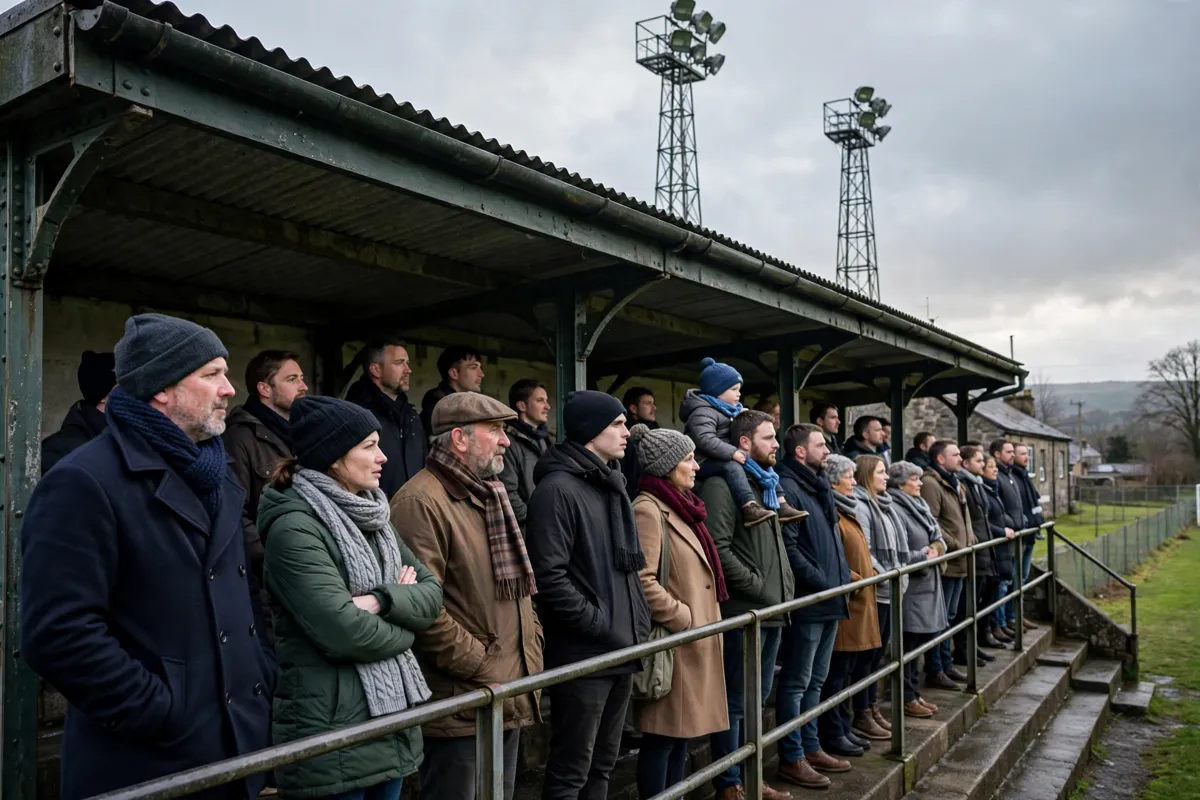
There is a particular kind of football that never makes the front pages, played in front of two thousand people on a wet Tuesday, where the man next to you has stood on the same spot for thirty years. Ask its supporters why they keep coming and few will talk about the quality of the football. They will talk about belonging. This is an argument that lower league football, for all its flaws, offers something the modern top flight increasingly cannot: a club that still belongs to its town, and a matchday that still belongs to its fans.
The Ground Is Part of the Town
Lower-league grounds sit inside their communities in a way that vast out-of-town stadiums rarely do. The walk to the match passes the same pubs, shops and streets the supporters live on, and the club’s badge carries the town’s name into every fixture list in the country. That connection is not nostalgia; it is geography. When a club’s ground is woven into daily life, supporting it becomes part of local identity rather than a leisure purchase, which is why generations of the same family end up in the same seats. Our look at football fan culture, community and matchday life in the UK explores how deep that bond runs.
You Are a Supporter, Not an Audience
At the top of the game, television schedules decide when matches happen and ticket prices decide who can attend. In the lower leagues, the relationship is simpler and more honest. Crowds are small enough that players hear individual voices, managers explain themselves to supporters’ trusts, and a few hundred season tickets genuinely matter to the budget. Fans feel the difference: their presence changes the atmosphere in a measurable way, because there is no wall of noise to hide in. Two thousand people singing in a ground built for ten thousand produce something raw that a choreographed arena show cannot replicate.
Footballers You Can Actually Reach
Lower-league squads are full of players combining football with ordinary lives, young loanees learning the trade and veterans extending careers they love. Supporters watch them develop at close quarters, sometimes over a whole career. A youngster who breaks through at a club like ours is remembered by first name years after moving on. That closeness builds a patience that the top flight has largely lost: a bad run is weathered together rather than punished with instant fury, because the fans know the people involved. Our coverage of grassroots football in Scotland shows where so many of those players begin the journey.
There is also an honesty to the finances that supporters appreciate. Everyone in a small ground understands roughly what the club earns and what it can spend, and a big cup draw or a player sale visibly changes what the club can do. Ambition is measured in improved floodlights, a secured young player on a longer deal, a stand repaired rather than a superstar signed. That transparency keeps expectations grounded and makes the good times, when they arrive, feel earned rather than bought.
The Matchday Costs What It Should
Price is not a romantic argument, but it is a real one. A family can attend a lower-league match, eat, and travel locally for what a single premium seat can cost elsewhere. That affordability keeps the crowd mixed: grandparents, teenagers at their first games, and parents introducing children who will become the next generation of season-ticket holders. Our guide to football tickets and matchday experiences looks at the practical side of planning a matchday, and the same principles apply in Lanarkshire as in London: book early, arrive early, and soak it in.
Imperfection Is Part of the Appeal
None of this requires pretending the football is secretly better. It is not, and nobody in the ground thinks it is. Passes go astray, pitches cut up in January, and promotion dreams usually die by March. But the stakes feel human-sized. A cup upset, a late winner in a derby, a young academy player scoring on his debut: these moments land harder in a small ground because everyone present feels personally connected to them. The growing number of women and girls building their own matchday traditions is adding to that culture too, as our guide to following the women’s game and our new guide to starting to play women’s football in Scotland both describe.
Even the Rivalries Are Personal
Derbies at this level carry a flavour the televised game cannot reproduce. The opposition fans work in the same towns, drink in the same pubs and went to the same schools, so the bragging rights are collected face to face on Monday morning, not through a phone screen. That keeps the rivalry intense but human: fierce for ninety minutes, then settled with a handshake and a pint. Players feel it too, because many of them are local, or have played for both clubs at some point in their careers. A derby winner in a lower-league ground is talked about in barbershops and bus stops for months, retold by people who were actually there. In an era when so much football is consumed as content, there is something quietly radical about a match whose meaning stays inside the community that produced it.
The Bottom Line
Top-flight football is a global entertainment product of astonishing quality, and there is room for both. But if football is supposed to be about community, identity and belonging to something bigger than a broadcast schedule, then the lower leagues are not a lesser version of the game. They are the original version, still running every Saturday in towns like this one, waiting for anyone who wants football the way it was always meant to feel. Come and stand with us once. That is usually enough.