
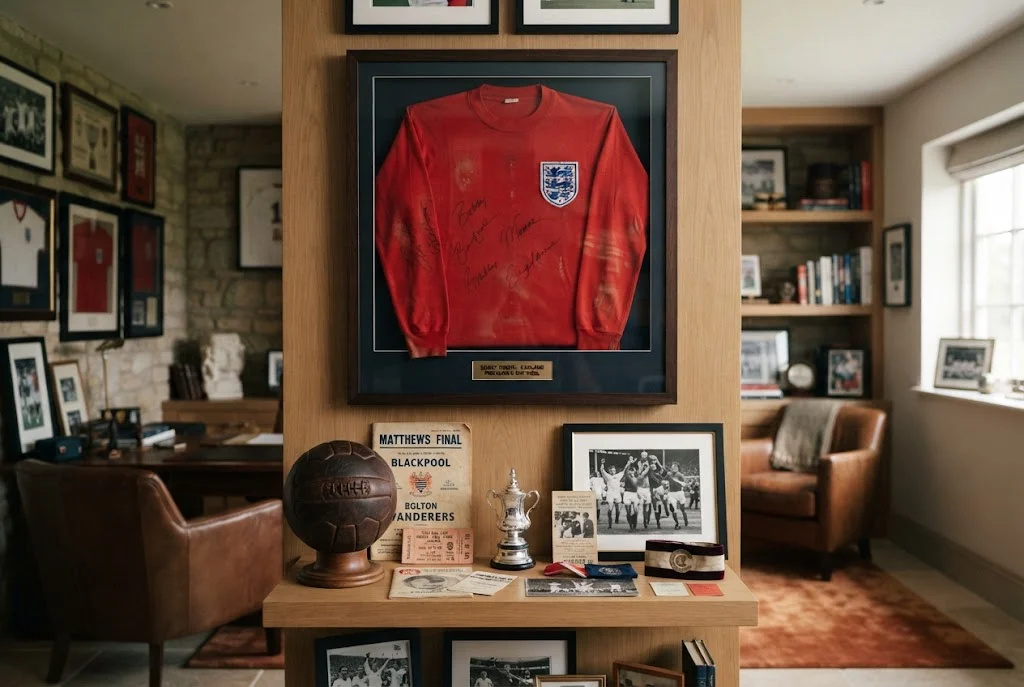
Understanding football memorabilia value is important whether you are buying your first signed shirt, selling an old collection or simply wondering what a piece of football history might be worth. A signed football shirt, match-worn jersey, historic programme or rare collectible does not have one fixed value. Its price can change considerably depending on authenticity, rarity, condition, provenance, the player or team involved and current collector demand.
Two items that look similar can therefore have very different values. A standard retail replica signed at a public event is not necessarily comparable with a match-worn shirt that can be linked to a major fixture. Likewise, a signature without reliable evidence can be much harder to value confidently than one supported by clear provenance and authentication.
For collectors, the most useful approach is to look beyond the name on the shirt and assess the complete story behind the item.
What Determines Football Memorabilia Value?
Several factors work together when collectors, dealers and auction houses assess football memorabilia. There is rarely one feature that determines the final price on its own.
The most important considerations usually include:
- Authenticity
- Provenance and documentation
- Rarity and scarcity
- Player or team significance
- Historical importance
- Condition
- Type of item
- Quality of the signature
- Current collector demand
- Previous comparable sales
UK auction specialists such as Dawsons also identify rarity, condition, authenticity, historical significance and association with major players or events as important factors when assessing sports memorabilia.
Authenticity Has a Major Impact on Football Memorabilia Value
Authenticity is one of the first things to consider when assessing football memorabilia value. A collector needs confidence that the item is genuine and that any signature has actually been produced by the player claimed by the seller.
This is especially important with signed football shirts, footballs, photographs and boots. A famous player’s name can create strong demand, but that demand also attracts counterfeit products and questionable signatures.
Documentation can help establish authenticity. Depending on the item, this might include a recognised certificate of authenticity, signing documentation, photographs, a matching authentication number or other evidence connecting the signature to the specific piece.
However, a certificate should not automatically be treated as proof that an item is valuable. Collectors should consider who issued it, whether it can be verified and whether the documentation actually relates to the item being sold.
Specialist collecting guidance also emphasises that authenticity and clear provenance are fundamental when buying signed football memorabilia.
How Provenance Can Increase Memorabilia Value
Provenance is the documented history of an item. In simple terms, it helps answer the question: where did this piece come from?
A shirt with a clear and credible history can be easier for a buyer to trust than an apparently identical shirt with no background information. Strong provenance might show where and when an item was signed, who obtained it, whether it was used in a particular match or how it moved from the original owner to the current seller.
This becomes especially important with match-worn memorabilia. If a shirt is claimed to have been worn during a significant match, supporting evidence can make a substantial difference to its credibility and potential value.
Photographs, match records, certificates, original purchase documentation and other relevant records can all contribute to a stronger provenance trail.
Does the Player Affect Football Memorabilia Value?
The identity of the player can have a significant influence on demand. Global football icons, legendary players and individuals associated with historic achievements generally attract a wider collector audience.
However, popularity alone does not tell the whole story. The specific context of the item matters too.
A shirt signed by a famous player may be desirable, but a shirt connected to an important moment in that player’s career could be considerably more interesting to collectors. For example, an item associated with a major final, record-breaking achievement or World Cup campaign may have a stronger historical story than an ordinary retail shirt signed during a routine session.
Catawiki’s memorabilia guidance similarly identifies player popularity, career success and the historical context surrounding when an item was signed as factors that can influence value.
Current Stars vs Football Legends
Current players can attract substantial demand, particularly when they are performing at an elite level. However, the market can change as careers develop.
Established legends may have a different type of appeal. Their importance to football history can continue to attract collectors long after their playing careers have ended. This can make memorabilia associated with iconic periods, clubs or tournaments particularly interesting.
Rather than assuming that the biggest current star automatically has the most valuable memorabilia, look at the item’s scarcity, history and collector demand as well.
Match-Worn Football Shirts Can Be Especially Valuable
The type of shirt is another important consideration. A standard replica shirt bought from a club shop is fundamentally different from a player-issued or match-worn shirt.
Match-worn shirts can command much stronger interest when there is credible evidence connecting them to a particular player and fixture. The historical story becomes part of the collectible.
There is an important distinction between:
- Retail replica: A commercially available shirt produced for supporters.
- Player-issued: A shirt prepared for a player or team use but not necessarily worn during a match.
- Match-issued: A shirt prepared for a particular fixture.
- Match-worn: A shirt demonstrably worn by a player during a match.
These categories should not be treated as interchangeable. The evidence supporting the classification is particularly important when assessing value.
Recent UK auction guidance notes that football shirt values can range from ordinary retro examples to extremely high-value historic match-worn pieces, with provenance, player significance, match context and authenticity playing major roles.
Does the Condition Affect Football Memorabilia Value?
Condition matters because collectors generally want items that have been preserved well. Fading, tears, stains, damaged signatures, missing labels and poor storage can all affect desirability.
That does not mean every mark reduces value in exactly the same way. For a genuine match-worn shirt, evidence of use can actually be part of its story. The important distinction is between authentic match wear and deterioration caused by poor storage or careless handling.
For standard signed memorabilia, a clean shirt with a strong signature and good presentation may appeal to more buyers than a heavily damaged equivalent.
Framing and Storage
Professional framing can help protect and display a shirt, but framing alone does not transform an ordinary item into a rare collectible.
If you are preserving memorabilia for the long term, avoid unnecessary exposure to direct sunlight, moisture and unsuitable storage conditions. Keeping certificates and provenance documents safely alongside the item can also make future valuation easier.
Why Rarity Matters to Football Memorabilia Value
Scarcity can increase collector interest. If thousands of identical signed shirts are readily available, buyers have more alternatives. If only a small number of authentic examples exist, competition can be stronger.
Rarity can come from several sources:
- A limited-edition release
- A historic shirt design
- A shirt from a short-lived season
- A player’s limited signing availability
- A match-worn item from a significant fixture
- A unique inscription
- A piece connected to an important tournament or achievement
However, scarcity only helps when there is demand. An extremely rare item from an obscure player or insignificant event may still have a limited buyer pool.
Signatures and Inscriptions Can Change Value
Signed memorabilia can vary considerably depending on the signature itself. A clear, authentic autograph from a highly sought-after player is generally more desirable than an uncertain or damaged signature.
Inscriptions can also add interest when they connect the item to a meaningful achievement. A shirt carrying a player’s signature alongside a relevant inscription may tell a stronger story than a generic autograph.
At the same time, additional signatures are not automatically better. A multi-signed shirt may become more valuable when it includes several important players from a legendary squad, but an unrelated collection of signatures can make the item less focused.
The context of every signature therefore matters.
Football Memorabilia Value and Historic Moments
Football is built around memorable moments, and those moments can become central to the value of memorabilia.
Items associated with World Cups, European finals, domestic title wins, record-breaking performances, famous goals and historic teams can have a particularly strong appeal. Collectors are often buying a physical connection to an event they remember or consider important in football history.
Historic relevance can also make an ordinary-looking item more interesting. A programme, ticket, medal, pennant or shirt may appear simple until its connection to a significant match is established.
This is one reason collectors should research an item’s history before deciding what it is worth.
How to Estimate Football Memorabilia Value
If you own a piece of football memorabilia and want an initial estimate, start by documenting exactly what you have.
1. Identify the Item
Record the manufacturer, club, season, player, shirt type and any other visible details. Take clear photographs of labels, badges, signatures and identifying marks.
2. Establish Authenticity
Gather certificates, receipts, photographs, emails and any other evidence that supports authenticity. If the item is signed, establish how and when the signature was obtained where possible.
3. Research Comparable Items
Look for similar pieces that have actually been offered or sold. Asking prices can be useful for understanding the market, but they are not the same as completed sales.
Compare items as closely as possible. A signed retail replica should not be compared directly with a match-worn shirt simply because both carry the same player’s autograph.
4. Consider Condition
Record any stains, fading, tears, repairs or damage. Also note whether the signature remains clear and whether the original labels and documentation are intact.
5. Consider Professional Valuation
If the item appears rare or potentially valuable, a specialist valuation can provide a more reliable assessment. UK auction houses such as Dawsons accept photographs and supporting documentation when assessing sports memorabilia for potential sale.
Football Memorabilia Value: Retail Price vs Resale Value
One common mistake is assuming that the original purchase price determines today’s value. It does not.
A shirt bought for a high retail price may have limited resale demand, while an older item acquired cheaply can become significantly more desirable if its historical importance increases.
Similarly, a seller’s current asking price is not proof of market value. The strongest evidence usually comes from comparable transactions and informed specialist assessments.
Collectors should therefore separate three concepts:
- Original retail price: What the item cost when first purchased.
- Current asking price: What a seller wants someone to pay.
- Market value: What informed buyers may realistically pay based on comparable evidence and current demand.
How Football Memorabilia Value Can Change Over Time
Memorabilia markets are not static. A player’s retirement, major achievement, transfer, death or induction into a prestigious football institution can affect interest. Major anniversaries and documentaries can also renew attention around historic teams and players.
Supply can change as well. If a player completes additional signing sessions, more autographed products may enter the market. That can influence scarcity and pricing.
For this reason, a valuation should be treated as a snapshot of the market rather than a permanent guarantee of future price.
Common Mistakes When Valuing Football Memorabilia
Several mistakes can lead owners to overestimate or underestimate what they have.
- Valuing the signature alone: The shirt, provenance and context matter too.
- Assuming a COA guarantees high value: Authentication and market demand are separate considerations.
- Comparing different shirt types: Match-worn and retail replicas belong to different categories.
- Using asking prices as proof: A listed price does not mean the item sold for that amount.
- Ignoring condition: Damage and fading can affect buyer interest.
- Overlooking provenance: A strong story is more useful when it can be documented.
- Assuming rarity equals value: Scarcity matters most when collectors actually want the item.
Should You Get Football Memorabilia Professionally Valued?
A professional valuation can make sense when the item appears unusual, historically important or potentially expensive. This is especially true when you are considering selling a collection, arranging insurance or deciding whether to consign an item to auction.
An experienced specialist can compare the piece with relevant market examples while considering authenticity, condition, provenance and historical importance.
For everyday memorabilia with little documentation, paying for a formal valuation may not always be necessary. However, if you suspect that a shirt, medal, programme or signed item could be significant, professional advice can prevent an avoidable mistake.
Building a Valuable Football Memorabilia Collection
Collectors do not necessarily need to chase the most expensive pieces. A focused collection can be more rewarding than a random collection of expensive items.
You might specialise in one club, one player, a particular decade, World Cup memorabilia, signed shirts or match-worn football clothing. A clear collecting theme makes it easier to research purchases and understand what makes each piece interesting.
Our broader guide to football memorabilia covers signed shirts, football collectibles and other items that can form part of a collection.
If you are particularly interested in Manchester United, Arsenal or other major clubs, specialist pieces can be assessed using the same principles: authenticity, provenance, rarity, condition, historical significance and demand.
Final Thoughts on Football Memorabilia Value
Football memorabilia value is ultimately about more than a famous name or an attractive shirt. The strongest collectibles usually combine authenticity, scarcity, condition, documented provenance and a compelling connection to a player, team or important football moment.
Before buying or selling, take time to establish exactly what the item is and what evidence supports its history. Research comparable examples rather than relying only on advertised prices, and consider professional advice when the item appears particularly rare or valuable.
Most importantly, remember that memorabilia has both financial and emotional value. A shirt connected to a legendary player or unforgettable match may be worth considerably more to one collector than to another. Understanding the market helps you make informed decisions, but the story behind the piece is often what makes collecting football memorabilia so enjoyable.