
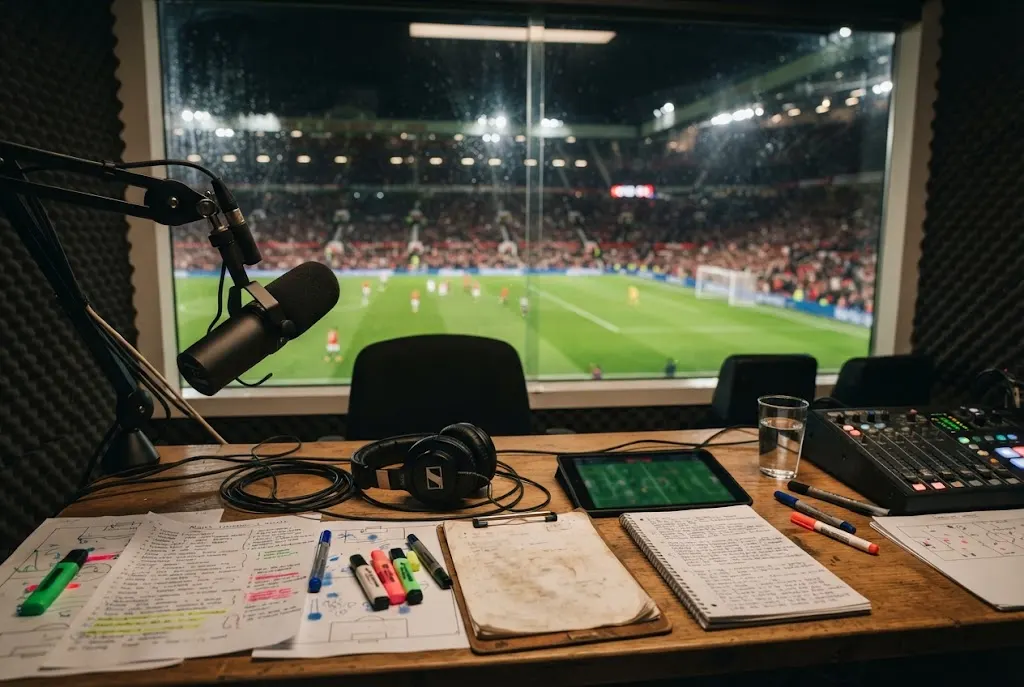
Football commentary charts offer a fascinating look at what happens behind the microphone during a live match. While supporters see the finished broadcast, commentators work with carefully prepared notes containing player information, statistics, match details and reminders that help them follow the action accurately.
For many fans, commentary appears spontaneous. In reality, much of the preparation takes place before kick-off. A commentator may spend hours researching players, managers, previous meetings and current form before producing a set of notes that can be used throughout the game.
Football commentary charts therefore provide an unusual glimpse into the preparation behind live broadcasting and help explain how commentators can respond quickly when something unexpected happens on the pitch.
What Are Football Commentary Charts?
Football commentary charts are preparation notes used by commentators before and during live football matches. They can contain information that allows a commentator to identify players quickly, remember important statistics and keep track of events during a fast-moving game.
The exact design varies from commentator to commentator. There is no universal template that every broadcaster follows. Commentary Charts, a project built around reproductions of professional commentator Clive Tyldesley’s preparation notes, explains that individual commentators prepare in different ways and that there is no single correct format. ([commentarycharts.com](https://www.commentarycharts.com/about/))
The project describes handwritten charts containing player and match data, goal statistics and miscellaneous information. The colour coding and layout are designed to help the commentator quickly find useful information while also providing a familiar preparation routine.
Why Do Football Commentators Need Detailed Notes?
Live football moves quickly. A commentator may need to identify a substitute, describe a tactical change, mention a player’s previous club and provide a relevant statistic within a matter of seconds.
Without preparation, this would be much harder. Even experienced commentators cannot be expected to remember every player, squad number, career milestone and historical detail for every match.
Preparation notes act as a reference system. Instead of trying to remember everything, the commentator can quickly glance down and find the relevant information.
This becomes particularly important during European competitions, international tournaments and busy domestic schedules where broadcasters may cover several matches in a short period.
What Information Appears on a Commentary Chart?
There is no fixed list of information that must appear on every chart. However, a well-prepared football commentary sheet may include several categories of information.
Player Information
Player names are among the most important elements. Commentators need to identify starters, substitutes and key squad members quickly.
Notes may include shirt numbers, positions, age, nationality, previous clubs or other relevant details. This helps avoid mistakes when a player enters the game or becomes involved in a significant incident.
Match Statistics
Historical and current statistics can add context to commentary. A commentator might want to know how many goals a striker has scored this season, how many appearances a goalkeeper has made or when a particular player last scored against the opposition.
These details are especially useful when a player reaches a milestone during the match.
Manager and Club Information
Commentary charts can also contain information about managers and clubs. A manager’s previous record against an opponent, a club’s recent form or a notable tactical trend can give the broadcast additional depth.
The objective is not to read statistics constantly. Instead, the information is available when the action creates a natural opportunity to use it.
How Commentators Use Charts During a Match
The preparation does not stop when the referee blows the whistle. Commentators continue using their notes throughout the match.
A typical sequence might involve a player scoring a goal. The commentator identifies the player, checks the player’s goal tally, considers whether the goal represents a milestone and then adds relevant context to the description.
All of this can happen within seconds.
That is why the layout of a commentary chart matters. Information needs to be easy to locate rather than buried in long paragraphs. A commentator who has prepared effectively knows where key information is positioned before the match begins.
Handwritten Charts vs Digital Preparation
Modern broadcasters have access to computers, databases and live statistical systems, so it might seem unnecessary to prepare handwritten notes.
However, some commentators continue to value physical preparation. Commentary Charts explains that its creator has handwritten a chart for every match since making his radio commentary debut in 1976, with the style and layout changing relatively little over the years. ([commentarycharts.com](https://www.commentarycharts.com/about/))
The same source describes the manual process as part of the learning and preparation routine. Writing information down can reinforce familiarity with the players and the match, even when the same information could technically be stored in a digital spreadsheet.
This highlights an important principle in broadcasting: technology can provide information, but preparation habits can still be personal.
The Psychology Behind Commentary Preparation
Preparation is not only about collecting facts. It can also give commentators confidence.
Commentary Charts describes the neat appearance of a completed chart as a psychological aid. Having a familiar structure can provide reassurance that the commentator has prepared properly before stepping into a live broadcast.
That matters because live commentary involves uncertainty. A match can change direction instantly. A player can score an unexpected goal, an injury can alter the tactical picture or a relatively unknown substitute can suddenly become the story of the game.
The commentator cannot predict everything. Good preparation therefore creates a foundation that makes reacting to the unexpected easier.
Football Commentary Charts and Memorable Matches
Some commentary charts become interesting historical artefacts in their own right.
Commentary Charts has reproduced preparation notes associated with major matches and iconic football occasions. The project explains that original charts have also been donated to charity auctions and club museums. ([commentarycharts.com](https://www.commentarycharts.com/about/))
That gives supporters a different way of looking back at famous matches. Instead of only seeing the final score or watching a replay, fans can examine the information a commentator had in front of them before the game began.
For collectors, this makes a commentary chart more than a sheet of notes. It becomes a piece of football broadcasting history.
Why Fans Find Commentary Charts Interesting
Football supporters are naturally curious about what happens behind the scenes. Stadium tours reveal changing rooms and tunnel areas, while documentaries show training sessions and dressing-room conversations.
Commentary charts reveal another part of the matchday experience: the preparation inside the broadcast position.
Fans can see how much research goes into a broadcast that may sound effortless. They can also appreciate the difference between knowing football and communicating football professionally.
A supporter may know every player in their own squad but still struggle to provide accurate, concise commentary for 90 minutes. Professional broadcasting requires preparation, concentration, timing and the ability to explain what is happening without distracting from the match itself.
TNT Sports and the Modern Football Commentary Team
Today’s football broadcast is rarely built around one commentator working alone. Major broadcasters use presenters, lead commentators, co-commentators, reporters and analysts.
TNT Sports provides a good example of this multi-person approach. Its football coverage includes commentators and co-commentators alongside presenters and pitchside reporters. Recent Champions League coverage, for example, has featured Rory Hamilton with Joe Hart providing co-commentary for Celtic’s meeting with LASK. ([fourfourtwo.com](https://www.fourfourtwo.com/features/who-are-the-commentators-and-pundits-on-tnt-sports))
The broadcaster’s football social channels also play an increasingly important role. Fans can follow match clips, statistics, breaking developments and commentary-related content through TNT Sports Twitter football coverage, helping extend the broadcast conversation beyond the television screen. ([x.com](https://x.com/footballontnt))
In August 2026, TNT Sports also introduced a new free-to-watch 30-minute version of its Early Kick-Off programme on YouTube before its Premier League broadcasts, demonstrating how football commentary and analysis are increasingly distributed across television and digital platforms. ([theguardian.com](https://www.theguardian.com/football/2026/aug/20/opening-half-hour-of-tnt-sports-premier-league-broadcasts-to-be-shown-on-youtube))
Football Commentary Is More Than Describing the Action
The best commentary does more than tell viewers what they can already see.
If a winger receives the ball, supporters can see that happen. The commentator’s job is to explain why the moment matters. That might involve identifying a tactical mismatch, recognising a player’s movement or adding historical context.
This is where preparation becomes valuable.
A commentary chart can contain information that transforms a simple observation into a meaningful piece of analysis. Instead of saying only that a player has scored, the commentator can explain that it is the player’s first goal since returning from injury or their first against a particular opponent.
That additional context can make a broadcast more engaging without overwhelming the viewer.
How Football Headlines Fit Into the Commentary World
Football commentary does not exist separately from the wider football media ecosystem. Supporters increasingly move between live broadcasts, social media, transfer coverage, match reports and specialist football websites.
Sites such as Footy Headlines focus heavily on football-related news, kits, boots and visual developments. Its current coverage includes new club kits, leaked designs, football boots and other equipment-related stories. ([footyheadlines.com](https://www.footyheadlines.com/))
This wider ecosystem gives commentators another source of context. A new kit, a transfer, a milestone or a tactical development can become part of the conversation surrounding a match.
For fans who follow these developments closely, commentary becomes another layer of the football experience rather than an isolated broadcast.
Could AI and Data Replace Commentary Charts?
Technology is already changing football broadcasting. Live data feeds can provide statistics almost instantly, while broadcasters have access to databases containing enormous amounts of player and team information.
However, information alone does not create good commentary.
A commentator still needs to decide which fact matters, when to mention it and how to explain it naturally. Too many statistics can make a broadcast sound mechanical, while too little context can make it feel superficial.
For that reason, digital tools are more likely to support preparation than eliminate it completely. A modern commentator can combine live data with personal notes, research and experience.
What Makes a Good Commentary Chart?
A useful chart should make important information easy to find under pressure.
Good preparation generally involves:
- Clear organisation: information should be easy to locate quickly.
- Relevant statistics: avoid filling the chart with facts that are unlikely to matter.
- Player familiarity: names, numbers and positions should be immediately recognisable.
- Historical context: include notable records and previous meetings where useful.
- Current information: injuries, form and recent developments can influence the broadcast.
- Flexibility: leave enough space to add notes as the match develops.
The exact layout is ultimately personal. What works for one commentator may not suit another.
Football Commentary Charts as Football Memorabilia
The popularity of commentary charts also demonstrates how football memorabilia is expanding beyond shirts, programmes and signed balls.
A chart connected to an iconic match can capture what the commentator knew and expected before the game started. That makes it particularly interesting when the match later becomes historically significant.
For collectors, the appeal comes from combining football history with broadcasting history. A chart can show player names, tactical expectations and statistics alongside the memory of what actually happened on the pitch.
That connection gives supporters another reason to explore the stories behind famous games rather than focusing solely on the final result.
Final Thoughts on Football Commentary Charts
Football commentary charts reveal just how much preparation sits behind a seemingly spontaneous live broadcast. Commentators need to know their players, understand the context and have relevant information available before the action begins.
The exact methods vary. Some broadcasters rely heavily on digital systems, while others continue to value handwritten notes and familiar preparation routines. The underlying principle remains the same: preparation gives commentators the confidence and information needed to respond when the match becomes unpredictable.
For supporters, these charts offer a fascinating behind-the-scenes perspective on football broadcasting. They show that great commentary is not simply about having a strong voice or knowing the rules. It requires research, organisation, timing and the ability to turn information into an engaging story.
As football broadcasting continues to expand across television, websites and social media, the role of preparation is likely to remain important. Whether the information sits on a handwritten page, a laptop or a live statistical dashboard, the objective is still the same: help the commentator make sense of 90 minutes of football for everyone watching.
For fans interested in the wider world of football media, commentary is only one part of the picture. Transfer reporting, broadcasting personalities, matchday experiences and supporter communities all contribute to the modern football conversation.